
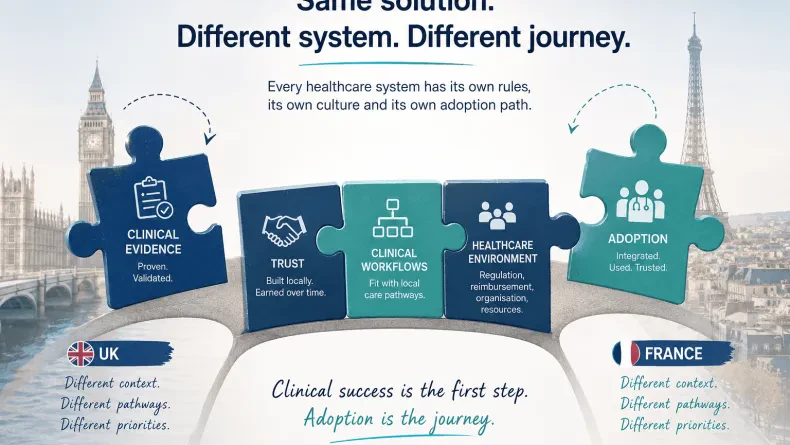
A digital health solution can be clinically validated and widely adopted in the UK, yet still face significant barriers to adoption in France.
Why Healthcare Localisation Goes Beyond Translation
At first glance, this may seem counterintuitive.
If a solution has strong clinical evidence, demonstrates positive patient outcomes and has already been successfully implemented within the NHS, why wouldn’t it be welcomed elsewhere?
Because healthcare adoption is rarely driven by evidence alone.
In France, healthcare professionals need to understand how a solution fits into their own clinical practice, care pathways and healthcare environment. A solution may be clinically effective, but that does not automatically mean it will integrate smoothly into another healthcare system.
The question is therefore often less about whether a solution works and more about whether it makes sense within the realities of the French healthcare system.
This distinction is particularly important when bringing healthcare innovation from one country to another.
The French healthcare system places strong emphasis on coordinated care pathways, collaboration between healthcare professionals and the integration of innovations into existing structures and practices. The French Ministry of Health describes care pathways as coordinated and continuous care involving different healthcare, social and medico-social professionals.
The Haute Autorité de Santé (HAS) also recognises that the adoption of digital health technologies requires more than demonstrating potential clinical value. Its work on professional digital technologies considers factors such as the impact on professional practice, economic consequences, feasibility and sustainability.
This is why localisation in healthcare goes far beyond language.
It is about understanding how trust is built.
It is about knowing how clinical decisions are made, how professionals collaborate, how patients move through the system, and where a new solution can genuinely add value without creating unnecessary friction.
It is also about understanding the expectations of the healthcare professionals who will ultimately use the technology.
France is actively developing its own framework for digital health and innovation. Its national digital health roadmap, for example, identifies improving care, supporting healthcare professionals and creating an environment conducive to digital innovation as key priorities.
In other words, successful international expansion is not simply a matter of translating a product, its website or its clinical materials into French.
It requires translating the value proposition into the language of the local healthcare system.
What worked in the NHS may still work in France.
But the journey to adoption may look very different.
The technology may be the same.
The healthcare culture, the system and the pathway to trust are not.
Pour aller plus loin
- Many UK digital health companies still see France as a difficult market to approach.
- Pourquoi externaliser la gestion de vos contenus multilingues ?
- La transcréation, késako ?
- La norme eIDAS : pilier de la confiance numérique en Europe et enjeu pour les professions juridiques
- Swantrad sur BFM TV : la legal tech qui révolutionne la traduction certifiée - "assermentée"
Commentaires